
Showing posts with label Preorder. Show all posts
Showing posts with label Preorder. Show all posts
Sunday, 8 March 2020
Story time...
"About two hundred metres to the south of the farm, as the hillside began to slope down towards the woods, I stopped and sniffed. Fifty metres or so to the right was an unmarked mutate grave, and to the left, another one about forty metres away. Even buried so deep I could still smell them; not entirely unpleasant, growing earthier as the worms fed. Dropping to my knees, I placed the body down carefully and pawed the ground, slicing away the upper crust to the crumbling dirt beneath, and dug. The rain fell heavier and swelled in the cavernous neck of the mutate. All sorts of scents lifted from the grass as the droplets disturbed them, and I closed my eyes, breathing deeply to take them in. I was still an adolescent back then, nascent in my senses, unaware from one day to the next how powerful one sense might be over another. Too dictated by the circadian rhythm of my blood and the rise and fall of the balance of my bodily chemicals. I could return tomorrow and only know the graves by the sight of the mounds. Or I could smell the nesting birds in the woods down below. I’d seen the mood swings of my brothers as they grew through puberty and into adulthood; teenage tantrums and fits of irrationality. Growing pains, I’ve read them called in books. Well, at sixteen, mine weren’t so much growing pains as mystery boxes to be unlocked, and sometimes locked away again."


Tuesday, 28 January 2020
PROLOGUE: The Risen Part II

I first menstruated when I was
nine years old; waking in bed to a small puddle of dampness, the morning light
warming through the heavy curtains. When I felt the wetness there was shame,
making itself known in the tears that came. It had been years since I wet the
bed. I sat up slowly, and it felt as though I’d tipped something over, such was
the gushing. The emptying. I squeezed
as hard as I could and finally it stopped coming. It was too cold in the winter
air and too warm beneath the layer of blankets to get up, so I guessed it was
still real early, and figured it would dry. Two hours later and the day at full
bloom was pressing into my bedroom, up the peeled wallpaper and the cracks of
plaster, black mould spots in the corners of the ceiling. I wriggled my hips.
It felt sticky. It would smell bad, I thought, wary of lifting the blanket.
Mother would not be happy. I tentatively put a hand down there, feeling for the
damp. Instead it was tacky, like wet cornbread dough, and when I brought my
fingers to the light they were the colour of the mould.
I’m mouldy! It was a silly thought, but
I was a child. I let in the ice of the air and there was the meconium stain on my
faded-blue pyjama bottoms, black-red and the size of a newborn kitten.
Shuffling backwards, the stain on the sheet was much larger, as black and as
wide as Rhodri’s well. It looked like
blood! I stifled a scream but the creaking springs of the mattress betrayed
my consciousness and Father came in to make sure I was quick with the chores,
as he always did. He took one look at the sheets, then back to me, and said;
“So you are a girl, after all.
Mother!”
I made
myself as small as I could, backing up against the wall, while Father left to
get Mother to deal with my problem. That he hadn’t acted much surprised settled
what frightened nerves were needling in my stomach. It couldn’t be that bad. Quiet, I listened to the footsteps of the
house; my brothers showed their heads around the edge of the door and laughed
when they saw the blood on the bed. I quickly reached forward and covered it
over, but it was too late. They ran off giggling, screaming “Raggedy Anne,
raggedy Anne!” as though I was meant to know what that meant.
Mother
finally entered, shutting the door behind her. She was the only woman in the
house, and, I guess, after today I became the second, though it would be
another five years until I menstruated again. She pulled the bedcover away and
then sat on the bed, asking if I was scared. I told her there was nothing to be
scared about, and she nodded in agreement, going on to tell me about the way of
things with that resigned sadness she had about her, as though she was
constantly experiencing something in the past. She told me to get up and then
she pulled the cover from the bed. “Go to the bathroom,” she said, locking my
bedroom door. I had my own bathroom, you see.
There, she
told me to strip and poured some freezing water into the plugged sink. I
sometimes made wee in the bathtub, which was green and black with dirt, so I
didn’t much want to stand in it, but I did as I was told. The pyjama bottoms
peeled away with some difficulty, much redder than the sheets, and stuck to my
thick, matted hair. My skin was already hard with goosebumps by then, the lighter
hair across my body prickled to attention, so the water made little difference.
It stung a little over my nub, as sensitive as the end was, but I was used to
that by now. Mother lathered soap into the hair on my inner thighs and up to my
belly button and cleaned away as much blood as she could. I couldn’t help but
notice how she averted her gaze from it,
and wouldn’t touch it. “There you
go,” she said, “you can do the rest yourself. I’ll leave a towel on your bed,
and get you clean sheets.”
Alone, I
finished washing and then dried and clothed, while my belly ached, hammering
blows bouncing around my abdomen. A little cramp. I always wore long trouser legs
and sleeves in those days, to cover all the hair. Even then little wisps crept
beyond the hem of my sleeves, so I wore gloves whenever we left the farm, just
in case we bumped into anyone. And a scarf for my neck.
Whenever I
think back to my early childhood, I always come back to this day, for so much
seemed to change for me from here on out. Father had it right: I was a girl. Not long after, I began to
malt, waking up in the mornings not to blood, or urine, but body hair. A little
later and my breasts began to grow sore, my nipples turning from pennies to old
tuppences. I grew my hair long, because that was what girls did. My brothers
stopped mocking and Mother even began to take me between her knees with a comb,
and brush and brush for minutes at a time. She’d always wanted a daughter, and
I was close enough, I guess. I don’t blame her, how do you treat an orphan baby
covered head to toe in hair and with seemingly both sets of genitals? It can’t
have been easy.
They named
me Ffion, and Father’s surname was Adie, as in A-D, so that was how the locals
knew me. Not that there were many locals to be had up here on the hill. Us
Adies liked to keep to ourselves most of the time, anyway, tending to our farm
and keeping the borders secure. If my family were muntjacs, then I was a vole,
or perhaps a mole, my own sect within a sect, the outsider within.
Father and Jack did the heaviest work; they both had the arms to show for it too. Up early to count the sheep and pigs and chickens, while I and Dylan fed them, and then it was the two hour walk, checking that the border was secure. Where the wind – for it blew a gale up here in the hills just north of Aberffrwd – had dislodged one of the giant tree trunks or bent a section of barbed wire, they were on it, fixing it in a jiffy. Aled was the youngest, though still older than me, and his morning routine was to collect all the water for the day from the nearby stream. When I was done feeding the animals, sometimes I might help Mother in the kitchen, but most often I went off by myself, and always had, ever since I was little. They never stopped me; if anything ever happened to me then I would be a mouth less to feed. Chances were slim – mostly – because that perimeter wall was sturdy. I saw them sometimes, prowling on the other side, testing the barbs and drawing blood. Licking their wounds. One sight of Father’s shotgun and they ran.


Friday, 19 July 2019
Tides of Hysteria on preorder - 0.99
Hi folks! Tides of Hysteria has been on preorder a while now but I just realised I hadn't blogged about it! And after Rebecca Gransden's 5-star review on Goodreads for Neon City I thought now might be a good time to shout it out loud! Here's a clip:
Tides of Hysteria is book two in the Neon City trilogy and will build on the suspense and action from book one, getting into the cracks of gutters and looking closer behind the glass of the Agridome. It'll be out early September and can be preordered for 0.99 pence or cents, before going to full price. As only book ones are ever free, this is your only chance to get it at a reduced cost!
It's time for a generation to take its final stand.
The Neon City trilogy continues with book two, Tides of Hysteria. With the citizen's eyes beginning to open, it's a race against time and a fight for truth to open them further, or close them forever.
For this book he visits the hyper-stylised world of future noir, creating a tense narrative featuring propulsive action and a plot harnessing classic crime and suspense themes. The backdrop is one of glossy opulence juxtaposed with grimy backstreets, moody rain flooding neon soaked streets. All very inviting.Thank you Rebecca!
Tides of Hysteria is book two in the Neon City trilogy and will build on the suspense and action from book one, getting into the cracks of gutters and looking closer behind the glass of the Agridome. It'll be out early September and can be preordered for 0.99 pence or cents, before going to full price. As only book ones are ever free, this is your only chance to get it at a reduced cost!
It's time for a generation to take its final stand.

The Neon City trilogy continues with book two, Tides of Hysteria. With the citizen's eyes beginning to open, it's a race against time and a fight for truth to open them further, or close them forever.
Thursday, 21 March 2019
Writing a Novel: Day Fourteen
Day One
It's day fourteen and I'm sitting at around 15k words. This is usually the point where I wrap up act one of my previous novels; perhaps I've built a hook into the narrative and I've either presented it to the reader, temptingly close, or I've caught them. Neon City is playing a little differently - it's more of a character driven plot with little authoritarian interference. The reader currently has all the information they need. Hopefully, it will engaging enough to stick with.


It's day fourteen and I'm sitting at around 15k words. This is usually the point where I wrap up act one of my previous novels; perhaps I've built a hook into the narrative and I've either presented it to the reader, temptingly close, or I've caught them. Neon City is playing a little differently - it's more of a character driven plot with little authoritarian interference. The reader currently has all the information they need. Hopefully, it will engaging enough to stick with.
I previously mentioned my plotting Excel sheet. There's various digital tools out there like Writers' Cafe and Scrivener, allowing you to move pixel-cards about on a virtual cork board, but it's all just ways to manipulate information. It comes down to how you want it presented to you. How you want to input the data. For me, opening Excel and jotting down the plot points I want to aim for, and being able to move them up and down as necessary, does the job. Making a line GREEN is more satisfying than it should be. When it's ALL GREEN - amazing!“No Yu this morning?”“She probably caught the early car,” answered Xi.“She was complaining again last night.”“What’s new?” He faced the window and the faint outline of their reflections like underwater creatures in a tank. No air. He watched Fei’s fish-like lips move, at once gasping and speaking.“If you’d turn up she wouldn’t have anything to complain about.”There was no intonation of malice, or emotion in general, as they spoke. Brothers passing yet another morning, talking through the mirror.“She says the same thing when you don’t turn up.”“Well she’s twigged that we’re never there at the same time.”“What are we going to do about it?”“Nothing. It won’t be forever.”“Do you ever feel bad?”

Sunday, 17 March 2019
Writing a novel: Day ten
Day One
Part of my own critical analysis is trying to judge how predictable my story is. I'm constantly asking myself this question, and equally I constantly remind myself that just because I may know where my story is going, and that it may seem obvious to me, a reader likely has no idea.
In the early stages I like to set the scene for what could be, offering the reader a myriad of possibilities. Hopefully these may form into small hooks, and in turn barbs, from which I've caught the reader. In reeling 'him' in I have to ensure that I keep teasing, not revealing my hand too soon.
Because at some point, the land becomes visible. The reader will know the landscape. By that time the reader needs to be invested and interested in my characters. Our characters. I've done something perhaps a little differently this time, inspired by recent readings of King and Hill, which is to inflect my characters with more of the mundane. Perhaps off-script remarks that give back story to item purchases, or reminiscences to past events - never too long or distracting, but something that adds flesh. It's not necessarily important to the story, but it makes the character more real.
Adds context to the landscape.
Brightens the darker areas.
I've become conscious of being too wordy - just that. Over-complicated description. Too dense sentences. Saying too much. For fear of losing track or focus, of there being too many pages for the reader. Then I'm reminded (thanks Twitter) that readers want to get lost in a story. They want a good book to be long. The important bit of 'long' though must be story, and contextual characterisation. Not dense and complicated language for the sake of that, for it pulls a reader out.
Story, story, story.
10 days: 9k words. I need to pick up the pace.
Day fourteen
Part of my own critical analysis is trying to judge how predictable my story is. I'm constantly asking myself this question, and equally I constantly remind myself that just because I may know where my story is going, and that it may seem obvious to me, a reader likely has no idea.
In the early stages I like to set the scene for what could be, offering the reader a myriad of possibilities. Hopefully these may form into small hooks, and in turn barbs, from which I've caught the reader. In reeling 'him' in I have to ensure that I keep teasing, not revealing my hand too soon.
Because at some point, the land becomes visible. The reader will know the landscape. By that time the reader needs to be invested and interested in my characters. Our characters. I've done something perhaps a little differently this time, inspired by recent readings of King and Hill, which is to inflect my characters with more of the mundane. Perhaps off-script remarks that give back story to item purchases, or reminiscences to past events - never too long or distracting, but something that adds flesh. It's not necessarily important to the story, but it makes the character more real.
Adds context to the landscape.
Brightens the darker areas.
I've become conscious of being too wordy - just that. Over-complicated description. Too dense sentences. Saying too much. For fear of losing track or focus, of there being too many pages for the reader. Then I'm reminded (thanks Twitter) that readers want to get lost in a story. They want a good book to be long. The important bit of 'long' though must be story, and contextual characterisation. Not dense and complicated language for the sake of that, for it pulls a reader out.
Story, story, story.
10 days: 9k words. I need to pick up the pace.
Day fourteen
Monday, 11 March 2019
Writing a novel: Day six
Day One
Is it six days already? I'm a bit behind schedule, as pacemaker shows:
It was a weekend, and they tend to be slower as I want to unwind and there's constant maitenance and other things going on. I'm quite pleased with what I've written so far. It's genre writing so will never win awards for prose, but so long as I keep engaged with it myself, then it should be engaging for readers too. At least that's the idea. The refinement can come in the edit.
Do other writers struggle with the early stages? In exposition? For me, the earliest stages are the easiest to write, as I probably have many walls and doors to the floorplan. And where there are gaps, these can be explored with a creative freedom, all while the character becomes fleshed out with back story and tics. The middle section (and these novels are written with a traditional three act style) is the toughest; I've found that the prose becomes more 'plodding' as it tries to hit more and more story beats, with so much of location and character already set up.
One trick, I suppose, would be to add more characters later on - at least side characters - or move the story to new locations. Or perhaps just looking at something from a different perspective. Hmm, something for me to ponder there. It's good, if you're a writer, to acknowledge where you may have flaws, and if you can see them yourself, with a critical eye, than all the better. I've seen flaws which no-one has picked up on in my own work; someone else perhaps didn't think they were flaws, but they were to me, and something to consider refining or fixing. After all, it will guide me - or you if you write - to a more rounded, accomplished, consistent writing style.
As a reader, it's inconsistency that grates me. It almost doesn't matter how the book is written (if legible) so long as it's consistent throughout. A non-genre piece of fiction may try to bend this rule, but it's probably best not to stray too far for story driven narratives.
Day ten
Is it six days already? I'm a bit behind schedule, as pacemaker shows:
It was a weekend, and they tend to be slower as I want to unwind and there's constant maitenance and other things going on. I'm quite pleased with what I've written so far. It's genre writing so will never win awards for prose, but so long as I keep engaged with it myself, then it should be engaging for readers too. At least that's the idea. The refinement can come in the edit.
A thousand hands pressing down kept him from rising. He couldn’t even reach the glass of water on the bedside. Nails dug into his brain and thankfully, eventually, the little death drew him back into its dark embrace.
Do other writers struggle with the early stages? In exposition? For me, the earliest stages are the easiest to write, as I probably have many walls and doors to the floorplan. And where there are gaps, these can be explored with a creative freedom, all while the character becomes fleshed out with back story and tics. The middle section (and these novels are written with a traditional three act style) is the toughest; I've found that the prose becomes more 'plodding' as it tries to hit more and more story beats, with so much of location and character already set up.
One trick, I suppose, would be to add more characters later on - at least side characters - or move the story to new locations. Or perhaps just looking at something from a different perspective. Hmm, something for me to ponder there. It's good, if you're a writer, to acknowledge where you may have flaws, and if you can see them yourself, with a critical eye, than all the better. I've seen flaws which no-one has picked up on in my own work; someone else perhaps didn't think they were flaws, but they were to me, and something to consider refining or fixing. After all, it will guide me - or you if you write - to a more rounded, accomplished, consistent writing style.
As a reader, it's inconsistency that grates me. It almost doesn't matter how the book is written (if legible) so long as it's consistent throughout. A non-genre piece of fiction may try to bend this rule, but it's probably best not to stray too far for story driven narratives.
Day ten
Friday, 8 March 2019
Writing a Novel: Day three
Day One
By day three the fingers are flying, and hopefully the ideas too. There's a quiet magic in conjuring worlds bit by bit - does anyone know where the little puzzle pieces appear from? The best feeling is when the brick walls don't appear and every sentence leads into the next, into the next, and so on, and you begin seeing a few sentences ahead. I guess this is called the zone. A curious state of solitude and focus.
Just where and how do I reach this mythical 'zone'? Well, practically speaking, I am able to work flexibly in the office, doing my weekly hours however I want, taking whatever breaks I want. So I tend to take an hour every day and use that either to read or write. At the moment, I'm writing, and can squeeze in 750-1000 words in that time. Drink of choice: tea.
In the evening, after the children are in bed, I'll generally write another 1000 words or so before retiring to relaxation: Netflix or the PS4. Drink of choice: still tea. I used to procrastinate over my writing space, and when I think back about all the time I've wasted because I didn't think it would work - that the 'space' was somehow 'wrong'. Using that as an excuse to not write that novel I'd always wanted to write - it's annoying. Now here I am: a desk in the children's playroom, surrounded by toys, and a desk piled with books and god knows what. Either that or a canteen table at work. Both work, because it's what's inside the head that matters. Like Stephen King notes in his On Writing, he wrote better beneath the stairs staring at a wall.
No distractions.
There's something to be said for public spaces though. I wrote almost the entirety of The Risen in the library, on the third floor overlooking a traintrack, a main road, and a river in the distance. That white noise of clicking keyboards and quiet murmuring, and using a computer that isn't yours and has none of your distractions on it, perhaps with headphones in listening to music, can be a lullaby to the imagination.
Day six
By day three the fingers are flying, and hopefully the ideas too. There's a quiet magic in conjuring worlds bit by bit - does anyone know where the little puzzle pieces appear from? The best feeling is when the brick walls don't appear and every sentence leads into the next, into the next, and so on, and you begin seeing a few sentences ahead. I guess this is called the zone. A curious state of solitude and focus.
The dome cracks may have been metaphorical, but the splintering society; the graffiti-daubed concrete fascias and crumbling brick walls, smashed glass and crime-darkened alleys, were the real deal. A man will do anything for money. A boy will lash out if there’s no future and no food in his belly. A mother will bleed for her children. It was a thousand stories played out in exactly the same way by actors who didn’t realise that just a generation or two earlier, this wouldn’t have mattered to them.
Just where and how do I reach this mythical 'zone'? Well, practically speaking, I am able to work flexibly in the office, doing my weekly hours however I want, taking whatever breaks I want. So I tend to take an hour every day and use that either to read or write. At the moment, I'm writing, and can squeeze in 750-1000 words in that time. Drink of choice: tea.
In the evening, after the children are in bed, I'll generally write another 1000 words or so before retiring to relaxation: Netflix or the PS4. Drink of choice: still tea. I used to procrastinate over my writing space, and when I think back about all the time I've wasted because I didn't think it would work - that the 'space' was somehow 'wrong'. Using that as an excuse to not write that novel I'd always wanted to write - it's annoying. Now here I am: a desk in the children's playroom, surrounded by toys, and a desk piled with books and god knows what. Either that or a canteen table at work. Both work, because it's what's inside the head that matters. Like Stephen King notes in his On Writing, he wrote better beneath the stairs staring at a wall.
No distractions.
There's something to be said for public spaces though. I wrote almost the entirety of The Risen in the library, on the third floor overlooking a traintrack, a main road, and a river in the distance. That white noise of clicking keyboards and quiet murmuring, and using a computer that isn't yours and has none of your distractions on it, perhaps with headphones in listening to music, can be a lullaby to the imagination.
Day six
Thursday, 7 March 2019
Writing a novel: Day two
Day One
It's day two! I won't be blogging each and every day, FYI - there's writing to get done! However, it was a solid start today - a nice round 1,000 words. For those of you interested, pacemaker is a nice little online app that you can use to keep track of writing goals.
https://www.pacemaker.press/
I'll take some screenshots as I go. I use it with a pinch of salt - I may want 60,000 words, but it could easily be more or less depending on where the story goes. This is not set in stone. At the moment pacemaker tells me 1200 words a day are needed. Well we'll see about that!
In the last post I mentioned my starting notes, well here they are:

Don't read too closely if you want to avoid spoilers! I'm sure many will be horrified at the scarcity, especially considering the second page is the entire trilogy. This to me is just the skeleton - the meat of the planning gets added beneath all my text as I go along. I make notes of character traits and points I want to hit, which will get translated into the spreadsheet if they are major moments.
For fun, here's a paragraph from the opening section, raw:
A lot will likely change. The challenge is getting it all down to begin with. The fun part is the editing. (I'm serious!)
Day Three
It's day two! I won't be blogging each and every day, FYI - there's writing to get done! However, it was a solid start today - a nice round 1,000 words. For those of you interested, pacemaker is a nice little online app that you can use to keep track of writing goals.
https://www.pacemaker.press/
I'll take some screenshots as I go. I use it with a pinch of salt - I may want 60,000 words, but it could easily be more or less depending on where the story goes. This is not set in stone. At the moment pacemaker tells me 1200 words a day are needed. Well we'll see about that!
In the last post I mentioned my starting notes, well here they are:

Don't read too closely if you want to avoid spoilers! I'm sure many will be horrified at the scarcity, especially considering the second page is the entire trilogy. This to me is just the skeleton - the meat of the planning gets added beneath all my text as I go along. I make notes of character traits and points I want to hit, which will get translated into the spreadsheet if they are major moments.
For fun, here's a paragraph from the opening section, raw:
Overpopulated and overstretched, Neon’s dome was splintering; district after district within bearing the brunt of an over-stimulated citizenry too eager and too bored to do anything other than reproduce. It was in their genes. It wasn’t their fault. There was space – the authority evicted whole families from top-side districts and relocated them to empty apartments beneath, to the sub-districts of pale lights and ever-night. It was a lottery. One day Joe and Jane Citizen were happily raising their family in the relative sunshine filtering through the dome’s skin, administering insurance accounts for the rich or wealthy or famous, or all three – and the next it was goodbye sun, goodbye rooftop barbecues, goodbye friends and family – unless they chose to move south too – and hello Negative Zero’s immigration barrier. Hello new home. Sure, the apartment might be twice the size as topside, but damn; the air was dank and sweaty and breathing it in made you feel as though you were filling your lungs with soup, all while looking out of tall, wide windows into blinking darkness and neon-punctuated misery.
A lot will likely change. The challenge is getting it all down to begin with. The fun part is the editing. (I'm serious!)
Day Three
Wednesday, 6 March 2019
Writing a novel: Day one
So, I thought it might be interesting to document my writing process for Neon City. I'm not sure how this will go, but it may highlight the highs and lows and triumphs and failures that pretty much every writer, I'm sure, will go through. Perhaps you're a reader, interested to see how an author plans and sets about achieving that mountain of a goal: writing circa 60,000 words (or more). Or maybe you're a fellow writer, looking for ways to avoid slipping up, giving up or otherwise WRITE!
I know I do that a lot.
Yet when I knuckle down, it does flow. I've now written - pinch skin - four novels. Would I give any of them 5 stars? No. But I'm hoping I would to the next one: Neon City. And if not that one, then the one after that.
All that is to say: I've been here before and just want each book to be better than the previous one. What I like about that is the formatted document is already done - sitting here with a title and spaces for copyright and chapter listings, and the oh-so-friendly About the Author at the end. I just need to fill the massive gap between.
I'm an indie author doing rapid release, so this book needs to be written in just a few weeks. I've given myself six. Other indies write more quickly, and slowly, have editors, don't have editors - whatever works for them. I write to this scale and have done since Nanowrimo a couple years ago, because it worked for me. I was inside the story every day. I believe that helped continuity of character.
 I also write and copyedit in my full-time job, so I'm skilled at editing on the go. An editor colleague also reads and offers a proof. It would be great to afford a third edit on my novels in the future!
So that's 60,000 words in ~6 weeks, give or take. 10,000 words a week. My best day is 5,500 words - so it's easily achievable. I have a vague outline in place of where I want the plot to be, and 3 main characters pencilled out, and that's enough for me. So far, for each of the Neon series, I've set the first act up as an intro to location, mixed with mystery and a sense of foreboding. It will be no different here.
Time to get to know Xi Chen - my MC #1! I use an excel spreadsheet to outline the plot, but I rely on my characters to tell me where to go. As I get to know them, I often find myself cutting and pasting sections out or in, moving them around, or just shutting it down and letting the plot flow. Something I'm taking from the first three Neon books is complexity of character. Complexity of morality. Nothing, and no one, is black-and-white. And that's sci-fi at its core. I'm looking forward to mixing in a bit of cyberpunk.
Day Two
I know I do that a lot.
Yet when I knuckle down, it does flow. I've now written - pinch skin - four novels. Would I give any of them 5 stars? No. But I'm hoping I would to the next one: Neon City. And if not that one, then the one after that.
All that is to say: I've been here before and just want each book to be better than the previous one. What I like about that is the formatted document is already done - sitting here with a title and spaces for copyright and chapter listings, and the oh-so-friendly About the Author at the end. I just need to fill the massive gap between.
I'm an indie author doing rapid release, so this book needs to be written in just a few weeks. I've given myself six. Other indies write more quickly, and slowly, have editors, don't have editors - whatever works for them. I write to this scale and have done since Nanowrimo a couple years ago, because it worked for me. I was inside the story every day. I believe that helped continuity of character.
 I also write and copyedit in my full-time job, so I'm skilled at editing on the go. An editor colleague also reads and offers a proof. It would be great to afford a third edit on my novels in the future!
So that's 60,000 words in ~6 weeks, give or take. 10,000 words a week. My best day is 5,500 words - so it's easily achievable. I have a vague outline in place of where I want the plot to be, and 3 main characters pencilled out, and that's enough for me. So far, for each of the Neon series, I've set the first act up as an intro to location, mixed with mystery and a sense of foreboding. It will be no different here.
Time to get to know Xi Chen - my MC #1! I use an excel spreadsheet to outline the plot, but I rely on my characters to tell me where to go. As I get to know them, I often find myself cutting and pasting sections out or in, moving them around, or just shutting it down and letting the plot flow. Something I'm taking from the first three Neon books is complexity of character. Complexity of morality. Nothing, and no one, is black-and-white. And that's sci-fi at its core. I'm looking forward to mixing in a bit of cyberpunk.
Day Two
Monday, 4 March 2019
Neon City - Now Available for Preorder

Book one in a cyberpunk, crime and mystery trilogy, Neon City follows on from the Neon Sands trilogy, with characters old and new fighting to break the chains of corruption.
Still early days on the blurb for this one, but it's always fun getting a book up on preorder so I couldn't wait any longer!
Tuesday, 18 September 2018
Flames of Apathy: Neon Sands Book 3 Preorder
Great news! The 3rd book in the Neon Sands trilogy is now on preorder - available 6 December. Special preorder price of 0.99!
CHECK OUT THE SERIES HERE

Far beneath the city’s depths burns far more than the fuel that feeds it.
What happens when equilibrium unbalances?
Will the people be ready for it?
Would they recognise it, even when it happened?
When Rylan finds new friends in old places, his passion for fairness and order is reignited. And when those new friends themselves become a target, he must make a decision: his mission or their lives?
Set within the bowels of Neon City, incessant rain shrouding an entire population with their hoods drawn up, book three of the Neon Sands trilogy burns as bright as the forges beneath the city – a ferocious final act.
CHECK OUT THE SERIES HERE

Far beneath the city’s depths burns far more than the fuel that feeds it.
What happens when equilibrium unbalances?
Will the people be ready for it?
Would they recognise it, even when it happened?
When Rylan finds new friends in old places, his passion for fairness and order is reignited. And when those new friends themselves become a target, he must make a decision: his mission or their lives?
Set within the bowels of Neon City, incessant rain shrouding an entire population with their hoods drawn up, book three of the Neon Sands trilogy burns as bright as the forges beneath the city – a ferocious final act.
Friday, 18 August 2017
Hereafter & Other Short Stories
I haven't done much shouting about this new title from me yet - the release date is the 25 August and it is currently on preorder on Amazon.

There's also an ongoing Goodreads Giveaway live right now if you wanted to request a free paperback copy!
 Enter Giveaway
If you'd like a review copy, hit me up at aj.smith@writeme.com.
Grab it here!
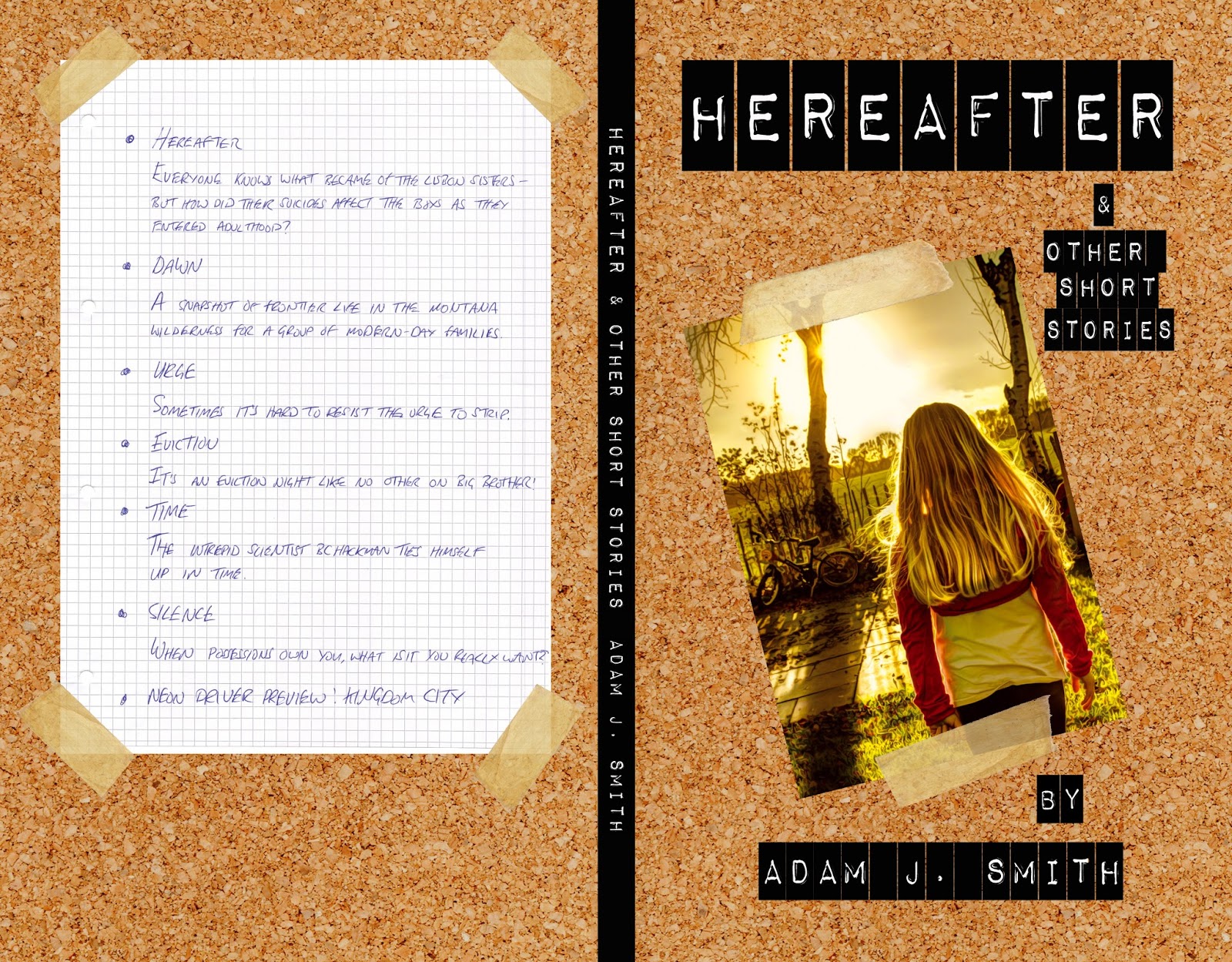
There's also an ongoing Goodreads Giveaway live right now if you wanted to request a free paperback copy!
Goodreads Book Giveaway
Hereafter and Other Short Stories
by Adam J. Smith
Giveaway ends August 26, 2017.
See the giveaway details at Goodreads.
See the giveaway details at Goodreads.
If you'd like a review copy, hit me up at aj.smith@writeme.com.
Thursday, 11 May 2017
New book coming out
Hi all - I'm pleased to announce I'm in the final proofing stage of my next release; a collection of eclectic short stories. Here's a sneak at the cover:

It will go on preorder soon. Additionally, review copies will be available. If you're in the UK you could even get a hard copy! Drop me an email at aj.smith@writeme.com if interested!

It will go on preorder soon. Additionally, review copies will be available. If you're in the UK you could even get a hard copy! Drop me an email at aj.smith@writeme.com if interested!
Subscribe to:
Posts (Atom)